Showing posts with label sunglasses. Show all posts

Monday, May 19, 2014

Babiators - sunglasses for children


We see a lot of kids at our Vancouver eye clinic. One important aspect of children's eye care is protecting young eyes from the sun. The eyes of children are much more vulnerable to damage from UV rays. The lenses in their eyes do not block as much UV radiation as in adults. Follow the same precautions as you would for an adult, but be sure to choose sunglasses that fit their smaller faces, have impact-resistant lenses, and have lenses large enough to shield the entire eye.

According to a new report issued by The Vision Council in May 2012, parents protect own eyes from the sun better than they protect their kids eyes. The report shows that while 73% of adults do wear sunglasses, only 58% of them make their children wear sunglasses.

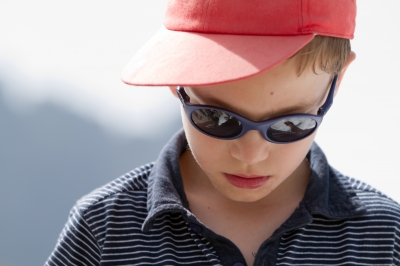
Parents may hold back on sunglasses for their kids because of cost or because kids are rough and forgetful with their eye wear resulting in lost or broken sunglasses. To fix this problem, we have begun carrying Babiators kids' sunglasses. The photo above is Dr. Randhawa's daughter wearing her new Babiators in the park. Babiators have a great guarantee to replace lost or broken sunglasses within one year, as long as you register your new pair of Babiators online.

Here is the guarantee straight from their website:


Babiators are durable — made to withstand whatever adventure your child dreams up. We know life can be a bit unpredictable, so should you lose or break your Babiators within one year of purchase, we'll send you a replacement pair — free. Simply register for your Lost & Found Guarantee within 30 days of purchase, and you're all set.register here

UV exposure over time causes eye disease and vision loss


The Vision Council report suggests that too many people still do not understand the serious damage that UV exposure can have on your eyes. Even fewer realize that it is cumulative exposure over time – which happens on both sunny and cloudy days – that leads to vision threatening diseases. One such disease, macular degeneration, leads to permanent vision loss and their is no cure.

The solution is to wear sunglasses and regular eye glasses with proper UV protection. Kids need this more than adults because the lens of a child’s eye is not as good as blocking UV rays as the lens of an adult eye. 

What cataracts and macular degeneration look like

Wearing sunglasses is a serious preventative health measure. Here is what macular degeneration can do to your vision:


UV damage also causes cataracts. Here is what cataracts can do to your vision:


Sunday, April 28, 2013

What is the best sunglasses lens in the world? Check the ESPF: eye-sun protection factor


What is ESPF?


ESPF is eye-sun protection factor - a way to measure the degree of UV protection provided by an eyeglass lens that was developed by the French optical company Essilor.

The higher the number, the higher the UV protection of a lens.  Most lenses that tout themselves as 100% UV protection, only block UV rays that hit the lens from the front - they block 100% the UV rays that hit the lens from the front only.  Those are ESPF 5 or 10 lenses.  Advanced UV technology lenses go up to ESPF 25 for a clear lens and ESPF 50 for a tinted sun lens.

With traditional UV lenses (the ones that only block rays form the front of the lens) you still get lots of  UV exposure from rays that reflect off the back of the lens and into your eyes, as shown in this diagram:


Some lenses, like Crizal Forte UV shown in the diagram, block UV rays that reflect of the back of the lens.  This gives you more than twice the UV protection of tranditional lenses.  Crizal Forte UV is an ESPF 25 lens.  It is the highest level of UV protection that you can get in a clear lens.

What is the best sunglasses lens?


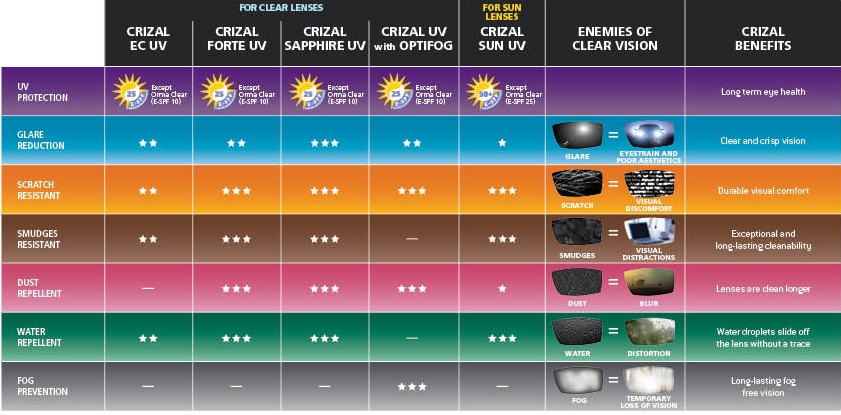
To get the maximum protection, ESPF 50, you need to go with the Crizal Sun UV lens, which is the only (as far as we know) dark tinted lens that blocks UV rays from the front as well as reflected UV rays.  See the chart tat the end of this post for a list of the available ESPF 25 and ESPF 50 lenes.

Why worry about UV exposure?


UV exposure to the eyes increases the risk of diseases like cataracts and macular degeneration, which can cause permanent vision loss.  It also leads to skin cancer around the eyes, which is the most common kind of skin cancer.

Other UV related dangers include Pingueculae (small yellowish bumps on the white of the eye) and pterygium (opaque growth over the surface of the cornea). The more UV exposure you have during your life, the more likely you are to develop one of these damaging conditions.

Here is what vision is like with macular degeneration:


Here is what vision is like with cataracts:


ESPF 25 and ESPF 50 Lenses


Kids' Sunglasses Warning - See for Life
Jun 01, 2011


Wednesday, September 26, 2012

Why do parents take better care of their own eyes than the eyes of their children?

I went to the Puyallup, Washington state fair last week.  It was a hot, sunny day and the fair was jam packed with kids and their parents.  Out of the hundreds, perhaps thousands of kids I saw that day, my kids where the only ones in sunglasses.  But at least half the parents I saw were in sunglasses.

Why do parents take better care of their own eyes than the eyes of their children?


Kids are not being protected from  UV radiation

My own observations at the state fair are confirmed by a report that was issued by The Vision Council in May 2012, that shows that while 73% of adults do wear sunglasses, only 58% of them make their children wear sunglasses.


UV exposure over time can cause eye disease and permanent vision loss

The report suggests that too many people still do not understand the serious damage that UV exposure can have on your eyes. Even fewer realize that it is cumulative exposure over time – which happens on both sunny and cloudy days – that leads to vision threatening diseases. One such disease, macular degeneration, leads to permanent vision loss and their is no cure..

The solution is to wear sunglasses and regular eye glasses with proper UV protection. Kids need this more than adults because the lens of a child’s eye is not as good as blocking UV rays as the lens of an adult eye.  Other diseases that you can protect against by wearing sunglasses are cataracts and skin cancer around the eye

Wearing sunglasses should be seen as a serious preventative health measure. Here is what macular degeneration can do to your vision:


UV damage also causes cataracts. Here is what cataracts can do to your vision:


Skin cancer around the eyes


Optometrists are always mindful of the possible development of skin cancer in the skin surrounding the eyes.

In fact, the eyelid region is one of the most common sites for nonmelanoma skin cancers. Skin cancers of the eyelid, including basal cell carcinomasquamous cell carcinoma, and melanoma, account for five to 10 percent of all skin cancers.  The best way to prevent this type is skin cancer is to reduce your exposure to UV radiation which comes with sunlight. The best way to do that is to wear sunglasses and eye glasses with advanced and more effective UV technology built into the lenses.

To learn more about skin cancer around the eyes, read the following studies:

  • Abraham J, Jabaley M, Hoopes JE. Basal cell carcinoma of the medial canthal region. Am J Surg1973; Oct; 126(4):492-5.


The right UV lens technology makes the difference


It is also important to realize that not all lenses are the same at blocking UV rays. Even lenses that claim 100% UV protection actually don't deliver on that promise. However, newer lens technologies are tackling that problem and provide much better UV protection.  These lenses, such as Crizal Forte UV lenses come with an ESPF 25 rating which denotes far superior UV protection than ordinary lenses. To learn more read our previous post on new UV lens technologies.  Another important thing to realize is that you can get advanced UV protection in non-sun eyewear.

Sunglasses now or botox later

Sunglasses and eyewear with advanced UV protection also have cosmetic benefits. They prevent wrinkles from developing around the eyes.  That will save you thousands of dollars in botox later in life!

Image od boy in sunglasses courtesy of chrisroll / FreeDigitalPhotos.net

Friday, June 1, 2012

Sunglasses buying tips


We know that sunglasses protect the eyes from harmful UV radiation that can lead to diseases like cataracts, macular degeneration (which is a leading cause of blindness in North America) and eye cancer.

But a recent survey by the Vision Council found that only 1 in 6 adults said eye health was the reason for wearing sunglasses (in fact health is the major reason to wear sunglasses). Two-thirds of respondents said that the purpose was to prevent glare.

So why do people not wear sunglasses? Here are some reasons found by the survey:

•  Nearly half simply forget.

• About 14% lose or break sunglasses often.

• About 20% don't believe their eyes are at risk from sun exposure.


That brings us to the See for Life Sunglasses buying tips.  These tips will help ensure that you wear your sunglasses often, that you don't loose them and that, as a result, your eyes remain healthy for life.

  1. Buy sunglasses that you love.  That way you are more likely to wear them and less likely to lose them.  If that means splurging on a pair of $350 Gucci sunglasses, consider it an investment in your eye health.  There.  Now you have an excuse to treat yourself.
  2. Consider multiple pairs.  All your sunglasses do not need to be expensive and it is useful to have multiple pairs to keep in the car, at work etc.  That way, if you do forget your sunglasses, you have backups.  A great way to get multiple pairs is to update your sunglasses every year or two.  The older pairs become your backups.
  3. Get new UV protection technology.  For the best UV protection, have your eye doctor give you lenses that protect you from UV radiation that reflects off of the back side of the lens (such as Crizal Forte UV).  This is very new technology and 99% of the sunglasses out there do not have it.  Traditional UV protection only stops UV radiation that comes at you from the front of the lens.  That's only about half of all the UV radiation that can get into your eye.  
  4. Bono wears them.  Sunglasses are fun and cool.  Sometimes its nice to just do something for the sheer fun and pleasure of it. 
  5. Check the ESPF.  Have your optometrist fit your sunglasses with ESPF 50 Sun lenses which provide the most advanced UV protection available today.  


Thursday, May 24, 2012

Parents take better care of themselves than their kids

Any parent would want to took after their child's health at least as well as they look after their own. But a parent can only do this if they have the right information.

Kids are not being protected from UV radiation


According to a new report issued by The Vision Council in May 2012, this is not happening when it comes to keeping eyes healthy by protecting them from harmful UV radiation. The report shows that while 73% of adults do wear sunglasses, only 58% of them make their children wear sunglasses.

UV exposure over time causes eye disease and vision loss


The report suggests that too many people still do not understand the serious damage that UV exposure can have on your eyes. Even fewer realize that it is cumulative exposure over time – which happens on both sunny and cloudy days – that leads to vision threatening diseases. One such disease, macular degeneration, leads to permanent vision loss and their is no cure.

The solution is to wear sunglasses and regular eye glasses with proper UV protection. Kids need this more than adults because the lens of a child’s eye is not as good as blocking UV rays as the lens of an adult eye.

What cataracts and macular degeneration look like

Wearing sunglasses is a serious preventative health measure. Here is what macular degeneration can do to your vision:


UV damage also causes cataracts. Here is what cataracts can do to your vision:


The right lens technology makes the difference


It is also important to realize that not all lenses are the same at blocking UV rays.  Even lenses that claim 100% UV protection actually don't deliver on that promise.  However, newer lens technologies are tackling that problem and provide much better UV protection.  To learn more read our previous post on new UV lens technologies.


Saturday, May 19, 2012

The myth of "100% UV Protection" eyeglass lenses.

Image: NASA
In honor of May as UV Awareness Month, See for Life is going to bust one of the biggest UV myths out there.  But first, if you want to learn more about UV exposure and eye health, read our post on UV basics and the diseases that UV exposure causes, just click here.

Lenses for glasses and sunglasses often tout "100% UV protection".  Does that mean that no harmful UV rays at all enter you eye?  No.  It means that the lens blocks all the UV rays that hit the front of the lens.  However, recent studies have shown that UV rays still enter your eyes because up to 50% of your UV exposure comes from rays that reflect off the back of the lens (the side closest to your eye) and into your eyes!  On top of that, we get 40% of our UV exposure on cloudy days.  So even if the sun is not shining bright, there is still lots of ultraviolet radiation pouring into your eyes even if you have standard UV protection lenses.

This means that so-called "100% UV protection lenses" only really give you around 50% protection.  That's better than nothing.  But there are new lens technologies on the market that can take care of all that reflected UV light so that you really do have total UV protection (or close to it).

The only lens that we are aware of that gives you total UV protection is the Crizal Forte UV lens (and other Crizal lenses that have the advanced UV protection). Here is a diagram that explains how it works.


You may think that you are not getting enough safety bang for your buck when you buy sunglasses.  And you would be right.  But there are some things you can do to get more out of your sunglasses.  Many sunglasses (even by the big designers like Gucci and Versace)  can accept prescription lenses and your eye doctor will be able tell you which models these are and how you can order them with custom lenses - the kind of lenses that you can get with technology like Crizal Forte UV. 

Of course, if you wear glasses normally you can get prescription sunglasses with Crizal Forte UV.  However, if you have perfect vision you can order your sunglasses with "plano" lenses, which are lenses that have no vision correcting power.  You can even take your old sungalsses to the optometrist and get new Crizal Forte UV lenses put into them.

UV exposure is very dangerous and over time it can lead to vision loss from diseases like cataracts and age related macular degeneration.

Here is what vision is like with macular degeneration:

Here is what vision is like with cataracts:


Download our UV education brochure by clicking on the image below.


Related Articles

What is the best sunglasses lens in the world?
April 28, 2013