Showing posts with label cataracts. Show all posts

Wednesday, April 1, 2015

Alcohol and cataracts

A new study pubished in the journal Optometry & Vision Science found that heavy alcohol consumption significantly increased the risk of age-related cataract. There was some evidence, but not as strong, that moderate consumption may help prevent cataracts. 

Cataracts require surgery to treat. The surgery is fairly common and usually results in a good outcome. However it is not without risks and bad outcomes like double vision and other problems can occur. It is best to avoid contracts altogether. Avoiding heavy drinking appears to be one way to do that.

Source:

Optometry and Vision Science: Official Publication of the American Academy of Optometry
Different Amounts of Alcohol Consumption and Cataract: A Meta-Analysis
Optom Vis Sci 2015 Apr 01;92(4)471-479, Y Gong, K Feng, N Yan, Y Xu, CW Pan

Wednesday, November 21, 2012

The eye nutrients that prevent blindness and also make you smarter

The connection between vision and cognition
Science has shown that increased lutein and zeaxanthin in the diet lowers the risk of cataracts and age related macular degeneration (AMD) two eye diseases that cause permanent vision loss. Catracts can be treated by removing the damaged lens of the eye and transplanting a new artificial lens but AMD has no treatment and the only way to fight it is through prevention.  New research suggests that these same nutrients improve cognitive function in the elderly.  Read more...

Related articles:

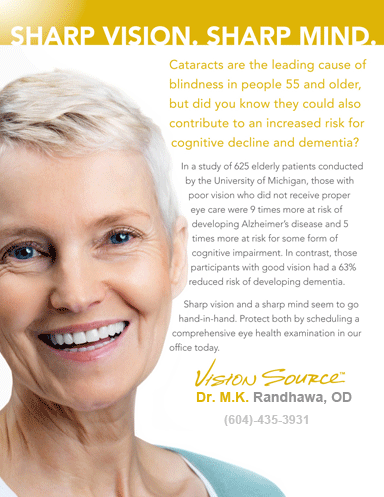
Sharp vision sharp mind

The miracle vitamin gets even more miraculous

Lutein and zeaxanthin - nutrients for eye health


For more information on eye nutrition, visit EyeNutrition.ca.

Thursday, May 24, 2012

Parents take better care of themselves than their kids

Any parent would want to took after their child's health at least as well as they look after their own. But a parent can only do this if they have the right information.

Kids are not being protected from UV radiation


According to a new report issued by The Vision Council in May 2012, this is not happening when it comes to keeping eyes healthy by protecting them from harmful UV radiation. The report shows that while 73% of adults do wear sunglasses, only 58% of them make their children wear sunglasses.

UV exposure over time causes eye disease and vision loss


The report suggests that too many people still do not understand the serious damage that UV exposure can have on your eyes. Even fewer realize that it is cumulative exposure over time – which happens on both sunny and cloudy days – that leads to vision threatening diseases. One such disease, macular degeneration, leads to permanent vision loss and their is no cure.

The solution is to wear sunglasses and regular eye glasses with proper UV protection. Kids need this more than adults because the lens of a child’s eye is not as good as blocking UV rays as the lens of an adult eye.

What cataracts and macular degeneration look like

Wearing sunglasses is a serious preventative health measure. Here is what macular degeneration can do to your vision:


UV damage also causes cataracts. Here is what cataracts can do to your vision:


The right lens technology makes the difference


It is also important to realize that not all lenses are the same at blocking UV rays.  Even lenses that claim 100% UV protection actually don't deliver on that promise.  However, newer lens technologies are tackling that problem and provide much better UV protection.  To learn more read our previous post on new UV lens technologies.


Wednesday, May 9, 2012

Are surgeons price-gouging cataract surgery patients?

When a patient has cataract surgery, the surgeon removes the eye's natural lens and implants an artificial lens is (called an intra-ocular lens).  The most basic lens is covered by government insurance in Canada but patients must pay out of pocket for higher quality lenses that will result in better vision.

The problem is the prices that surgeons are charging their patients.  Some prices are outrageously high and there is great variability between what different surgeons will charge for the same lens.  It's difficult for patients to shop around because you can't just walk into a store and read the price tag.  Moreover, surgery centers will often not tell you the price over the phone.

When a patient is faced with the authority of a surgeon in the exam room, it can be intimidating and difficult to question the surgeon's recommendation to buy premium lenses or to question the price being charged.

A recent study published in the journal PLoS ONE examined this issue. The researchers posed as patients and  telephoned every cataract surgeon in Ontario, Canada, and asked their price for the most common type of specialty intra-ocular lens. They then measured the total prices quoted and price variation between surgeons.

The study concluded that although cataract surgery is covered by public health insurance, some eye surgeons charge much more than others for the same intra-ocular lens and associated testing. The researchers urged that greater access to price information and better regulatory control could help ensure that patients receive fair value for out-of-pocket health expenses.

In British Columbia pricing by surgeons was such a concern that the provincial government took over the market for intra-ocular lenses, using its buying power to get a good deal on the lenses and then to provide them to the public at cost.  You can read the press release from the ministry of health here.

Often the best and most objective advice about specialty cataract surgery lenses comes from your optometrist. As eye doctors, they have the knowledge and experience to give you sound advice and because they are not the ones earning fees form doing the surgery or selling the lenses, they have no financial conflict of interest in helping you make the best choice.


Wednesday, April 20, 2011

Vegetarians and vegans have a lower risk of cataracts than meat-eaters

Another point for the vegetarians!  There is a new British study published in the The American Journal of Clinical Nutrition (it's in the March 2011 issue, if you want to read it) that concludes that vegetarians and vegans have a much lower risk of cataracts than meat-eaters. 

The researchers monitored the medical records of 27,670 non-diabetic people aged 40 or over to see if and when they developed cataracts. They found a strong correlation between a person's diet and cataract risk.

One remarkable thing about the correlation is that the risk was highest for high meat eaters (those that eat more than 3.5 ounces of meat a day).  The next highest risk was for moderate meat eaters, then low meat eaters, followed by fish eaters (people who eat fish but no other meat).  Vegetarians and vegans had the lowest risk. This means that reducing your meat consumption, even if you do not become fully vegetarian, will reduce cataract risk.  There was a big difference in risk between vegans and meat eaters.  The risk for vegans was about 40 percent lower than it was for the high meat eater category.

What are cataracts?

Cataracts are a clouding of the eye's crystalline lens that usually develops slowly over time. (In the case of post-traumatic cataracts, however, they can also occur very quickly.) It is the leading cause of poor vision in adults.

What if you have cataracts?

I routinely diagnose cataracts and if surgery is required to remove them, I refer patients to a good surgeon.  With today's surgical techniques the surgery can be as quick as 15 minutes!  However, all surgery has some risk and should not be undertaken lightly. 

And with cataract surgery it will cost you several hundred dollars for a good quality replacement lens if you want the best vision (MSP pays for the most basic lens but it is definately far from the best).  It is always better to prevent the condition for occurring.

Watch this video to learn how cataract surgery is done.  The video makes it look simple but there is much more to it than the video suggests.