Monday, October 21, 2013

Life demands more than 20/20

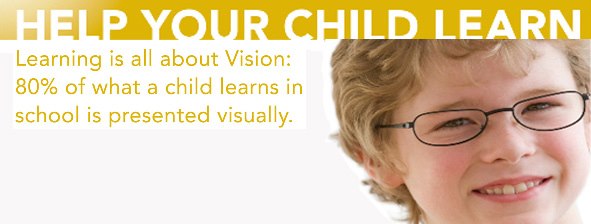
In order for children to learn well, they need to see well. Parents may not realize there is more to good vision than 20/20 and that there are conditions that vision screenings can miss. Two optometrists conducted a visual experiment where common visual problems known to affect learning in kids are simulated in 4 adult teachers, and their experience and reaction are discussed.


Related Articles


Behaviors in children that indicate a visual-perceptual problem requiring a visit to a developmental optometrists

Saturday July 27, 2013


Research confirms vision therapy can Improve reading comprehension and improve a child's overall attention in the classroom
Friday, July 5, 2013

Visual Input Important in Developmental Dyslexia
Tuesday, July 2, 2013

If your child has reading problems, treatable vision and eye movement disorders may be the reason
Sunday, June 9, 2013

Visual processing and learning disorders 
Apr 17, 2013

60% of learning disabled students failed two or more binocular vision tests
Oct 20, 2012

More visual symptoms means lower academic performance
Feb 29, 2012

Vision therapy for convergence insufficiency improves academic performance ...
Jan 16, 2012

82% of teachers report an improvement in students after vision therapy 
Jun 16, 2012

Binocular vision dysfunctions ate my homework 
Mar 31, 2012

Study proves that vision problems interfere with learning

map | directions | FREE parking | book an appointment

Tuesday, October 8, 2013

Are school vision screenings enough?

School vision screenings are not enough and often give parents a false sense of security about the health of your child's vision and eye health. A comprehensive eye exam provides the full assurance of vision and eye health that a simple eye chart test or a school vision screening cannot. 

Eye diseases, many that can cause blindness, eye movement problems such as convergence insufficiency and binocular vision disorders, eye muscle control disorders and visual information processing deficits all go undetected in a rudimentary vision screening.  Many of these disorders can impact a child's school performance, their personality and their self esteem. Undiagnosed diseases can cause permanent vision loss.

Dr. M.K. Randhawa explains:


map | directions | FREE parking | book an appointment 


Monday, September 30, 2013

Kids' eyeglass frames - the top three features to look for

Did you know? Only 10% of all eyeglass frames are made for children.

There are a number of child friendly features to look for in children's frames.  Here are the top three.  Read more...


Sunday, September 29, 2013

Which children benefit most from orthokeratology myopia treatment?

Myopia treatment in Vancouver, BC.
Orthokeratology is effective in slowing or stopping myopia in children. A new study helps doctors determiner which patients will benefit the most from orthokeratology treatment.

A new study published in the journal Optometry & Vision Science sought to determine which children would benefit the most from the orthokeratology to slow or stop their myopia progression.

Here is our definition of orthokeratology:

Orthokeratology is a vision correction treatment that reshapes your cornea while you sleep so that you have perfect vision during the day. No glasses, no contacts, no surgery. Orthokeratology is also sometimes caled "corneal reshaping", "corneal molding", "overnight vision correction" or "ortho-K". Orthokeratology is most effective for near sightedness and astigmatism. Lens designs for farsightedness are under development. - See more at: http://www.orthokeratology.ca/what-is-orthokeratology.html#sthash.BJiPJf5m.dpuf

There are many studies that support orthokeratology to slow or stop the progression of myopia. This study wanted to find out which children would benefit the most from ortho-k.

Orthokeratology (OrthoK) in Vancouver BCThe researchers evaluated baseline measurements in myopic children fitted with overnight orthokeratology retainer lenses and compared these to measurements in a  group who wore glasses.  The authors then analyzed their data to figure out which measurements predicted myopia progression.  The standard measurement of myopia progression is to measure the axial length of the eye.  In myopia, the eye grows longer and if this effect is slowed or halted altogether, a child's eyes will stop getting worse.

The study identified number of factors that can help eye doctors predict which myopic children might benefit from overnight orthokeratology retainer lenses to control axial length growth and hence myopia progression.

The study found that the children who experienced the greatest myopia slowing effect were those who were older, had earlier onset of myopia, were female, had lower rate of myopia progression before baseline, had less myopia at baseline, had longer anterior chamber depth, had greater corneal power, had more prolate corneal shape, had larger iris diameter, had larger pupil sizes, and had lower levels of parental myopia.

The study also highlights the need to see a doctor who is highly trained in ortokeratology. A great deal of knowledge is required to ensure that the right patients are selected and that orthokeratology is not prescribed indiscriminately.

Related articles

Orthokeratology slows or stops the progression of myopia in children
July 6, 2013

Study suggests that young children may benefit from orthokeratology
February 14, 2013

New study confirms orthokeratology for slowing myopia progression
January 30, 2013

Orthokeratology is shown to be safe for correcting myopia in chidlren
Aug 11, 2012

Orthokeratology is shown to be effective in correcting astigmatism and myopia
Jun 18, 2012

New study supports orthokeratology for myopia control and for astigmatism correction
Jan 10, 2012

Laser eye sugery makes you queasy? Orthokeratology is a safe and effective alternative
Jun 09, 2011


Saturday, September 28, 2013

Why Apple's iphone 5s and iOS7 make people dizzy, motion-sick and nauseous - you may have Neuro-Ocular-Vestibular Dysfunction


Motion sickness, dizziness, vestibular treatment in Vancouver, BC
Many Apple iPhone users are complaining that the new iOS7 operating system makes them dizzy, sick and nauseous.  In one article from ABC News, users are reported as experiencing the following symptoms:

One user says "It hurts my eyes and makes me dizzy. So annoying that we can't downgrade!!!!" Another writes, "I had severe vertigo the minute I started using my ipad with ios 7. Lost the rest of the day to it... And not happy at all. It's the transition between the apps flying in and out."
People are experiencing a form of motion sickness caused by the transition animations in iOS7. They may have unwittingly diagnosed themselves with a vision or eye movement problem.  

We treat many patients for a problem called Neuro-Ocular-Vestibular Dysfunction (also known as "see-sick syndrome" or "supermarket syndrome") where they experience motion sickness like symptoms arising from dynamic visual stimuli, even when they are not in a vehicle.  The visual stimulus of a super-market, stripes on a shirt and now perhaps even the iPhones iOS7 operating system can trigger motion sickness type symptoms. 

The problems often arises from binocular vision disorders - eye movement problems where the eyes do not work together as a team properly. Studies have shown thatvertigo and dizziness is an underestimated symptom of eye and vision disorders.

The fact that vision and eyes are an under-recognized cause of dizziness, vertigo and motion sickness means that many people spend a year or more seeking help from various doctors who fail to diagnose the problem before finding an eye doctor who can zero in on the cause. One recent case found us one when she went to her optometrist after consulting various doctors for over a year. The optometrist found that the patient's eyes were misaligned, a condition that commonly causes the dizziness and vertigo-like symptoms she was experiencing. The patient was referred to our Vancouver eye clinic for treatment.

Dynamic adaptive vision therapy is an effective treatment for see-sick syndrome. Vision therapy relies on the principle of neuroplacticity and involves a doctor and therapist treating the patient with exercises and special equipment to "re-wire" the eye-brain connection and improve visual skills. In this way, vision therapy is similar to speech therapy or occupational therapy but focused, of course, on the eyes and visual system.

Related Articles

See sick syndrome
Jul 29, 2013
See Sick Syndrome, also known as Neuro-Ocular-Vestibular Dysfunction (NOVD), is a combination of motion sickness and photophobia that negatively affects quality of life, but is almost always unrecognized by medical ...


Motion sickness and vision therapy - See for Life
Apr 18, 2012
MSNBC recently did a story on adult onset motion sickness. One of the doctors interviewed for the article was optometrist, Dan L. Fortenbacher, O.D., FCOVD, who treats motion sickness using vision therapy. Here is an ...

Vertigo is often a symptom of eye disorders - See for Life
Apr 20, 2013
As we see more and more patients in our Vancouver optometry clinic with vertigo caused by eye disorders, we are reminded of an important study that was published on the topic over a decade ago by researchers from France ...


More articles on iOS 7 and motion sickness

New iOS 7 update making some users dizzy
Detroit Free Press
Apple customers have taken to Apple message boards and Twitter to complain that the flashy graphics in the new operating system for the ...

Apple iOS 7 Literally Making Some Users Sick
ABC News‎

Make iOS 7 less nausea-inducing
  1. Macworld (blog)